
When Weekly Therapy Isn't Enough: Is an Intensive Right for You?

You show up every week. You do the homework. You like your therapist. And still, some part of you wonders why it feels like you're circling the same memory, the same trigger, the same knot in your chest.
By the time you've settled in, caught up on your week, and started to touch the thing that actually hurts, the 50 minutes are almost up. You close it back down, drive home, and spend the next seven days holding it all together until you can open it again.
If that sounds familiar, nothing is wrong with you, and therapy isn't failing you. It may be that the shape of your therapy isn't matching what your healing needs right now. For many people carrying trauma or a painful experience that won't settle, that's where an EMDR therapy intensive comes in.
The short answer:
An EMDR therapy intensive may be right for you if you feel stable day-to-day but stuck on a specific memory, experience, or trigger, and weekly sessions keep ending just as you reach the real work. An EMDR therapy intensive condenses Eye Movement Desensitization and Reprocessing (EMDR) therapy into longer, focused sessions over a half day, a full day, or several days in a row. It tends to fit best when you have a clear target, enough support and stability outside of therapy, and time to rest afterward. It's usually not the best first step during an active crisis or when you need steady week-to-week support more than deep processing.
Below, we'll walk through the signs that weekly therapy might not be enough right now, why EMDR in particular lends itself to an therapy intensive format, and how to tell whether you're ready.

6 Signs Weekly Therapy May Not Be Enough Right Now
Weekly therapy is the right rhythm for many people and many seasons of life. But certain patterns suggest you might benefit from the extended, focused time of an EMDR therapy intensive.
You spend most of each session getting back to where you left off. Re-orienting and settling your nervous system can take 15 to 20 minutes. EMDR reprocessing often needs a longer runway than what's left.
You open a memory up, then have to close it down too soon. In EMDR, reprocessing a memory sometimes takes longer than one session allows. Stopping part way and waiting a week can leave you feeling raw in between.
You understand your trauma, but your body hasn't caught up. You can explain why you react the way you do, yet the panic, shutdown, or flinch still shows up. EMDR works with how a memory is stored in the brain and body, not just how you think about it.
There's one specific experience you keep circling. A difficult birth, a medical event, a loss, an accident, or a single painful memory you want to address directly rather than work around. EMDR therapy intensives work best with a clear target like this.
Your schedule makes consistent weekly sessions hard. New parents, caregivers, and people with demanding jobs often struggle to protect the same hour every week. Missed sessions slow EMDR's momentum.
You've done the groundwork and feel ready to go deeper. You have coping skills, you feel resourced, and you'd rather give dedicated time to reprocessing than stretch it across many months.
Noticing one or two of these doesn't automatically mean you need a different format. It does mean it's worth asking your therapist whether an EMDR therapy intensive could help you move forward.

What a Therapy Intensive Is (and Isn't)
A therapy intensive is a block of extended, focused therapy time, often several hours in a single day or spread across a few consecutive days. Instead of 50 minutes a week, you and your therapist work on one clearly defined goal without the interruption of a week between sessions.
What an intensive is:
A structured, planned format built around a specific focus, like a traumatic memory, a birth experience, or a stuck pattern
Paced with care, with time built in for grounding, breaks, and nervous system regulation
Often centered on approaches like EMDR, which lend themselves to longer processing time
Preceded by preparation and usually followed by integration support
What an intensive isn't:
A crisis service or a replacement for emergency care
A marathon talk session where you're pushed past your limits
A sign that weekly therapy "didn't work" or that you did something wrong
A one-size-fits-all fix for every concern
How the experience differs from weekly therapy
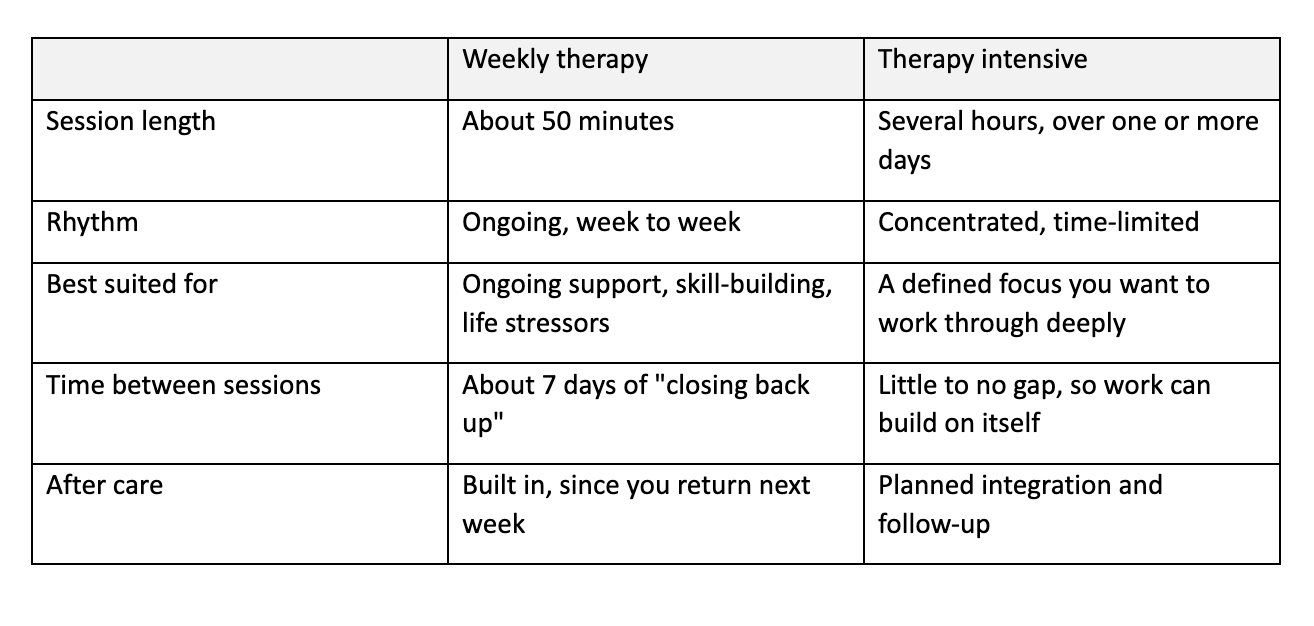
Many people use both: an intensive to move through a specific stuck point, and weekly sessions before or after for support and integration. You can learn more about how Wise Roots structures this work on our therapy intensives page. If you're specifically weighing EMDR formats, see our post on EMDR intensives vs. weekly EMDR goes into more detail.

Who Intensives Tend to Help Most
Intensives aren't only for people with a certain diagnosis or history. They tend to be a good fit for people who:
Have a specific trauma or experience they want to process, such as a difficult birth, a medical event, a loss, or a single overwhelming incident. (Our trauma therapy page explains more about how trauma shows up.)
Are new parents or caregivers who can arrange one focused block of time more easily than a standing weekly appointment.
Already have a therapist and want to go deeper on one issue, with support from their weekly therapist.
Feel generally stable in daily life, with work, relationships, and routines that are holding.
Want to see meaningful movement sooner and have the time and space to rest afterward.
When it may be better to wait
An honest answer matters here. An intensive may not be the right next step if you are:
In an active mental health crisis or having thoughts of harming yourself
Actively using substances to cope in a way that makes it hard to stay present
Without a support system or a safe, quiet place to land after sessions
Facing major instability right now, like housing, safety, or a big life upheaval
In those seasons, steady weekly support and nervous system work, like somatic therapy, often lay the groundwork first. Waiting isn't a failure. It's part of pacing your healing so it can actually hold. A good therapist will help you figure out the timing, and will tell you honestly if an therapy intensive isn't the right fit yet.
If you're in crisis, call or text 988 (the Suicide & Crisis Lifeline) or go to your nearest emergency room.
Questions to Ask Yourself Before Choosing an Intensive
If you're on the fence, sit with these questions. There are no wrong answers, only information about what you need right now.
Is there a clear focus? Can I name the memory, experience, or pattern I most want to work on?
Am I resourced? Do I have ways to calm my body when I'm upset, and people I can lean on?
Can I protect the time? Can I clear a full day (or several) plus some quiet time afterward, without work or caregiving pulling me away?
What am I hoping will change? Do I have a sense of what "better" would look and feel like?
What support will I have after? Will I continue with weekly therapy, or have a plan for follow-up sessions?
If you answered "yes" or "mostly" to most of these, an intensive may be worth exploring. If several felt uncertain, that's useful too. It may point to a bit more preparation first, which a therapist can help you build. Either way, a short consultation is the easiest way to find out where you are. You can read how preparation, sessions, and follow-up work on our intensive therapy page.
FAQs:
-
Weekly therapy may not be meeting your needs if you often spend sessions catching up, leave feeling stirred up but unfinished, or understand your patterns without feeling any different in your body. That doesn't mean therapy is failing. It may mean you'd benefit from longer, more focused time on a specific issue.
-
Yes. Many people complete an intensive while continuing to see their regular therapist. With your permission, the two clinicians can coordinate so the intensive supports the work you're already doing rather than replacing it.
-
It doesn't have to be. A well-structured intensive includes preparation, breaks, grounding, and nervous system regulation throughout. You stay in control of the pace, and your therapist will slow down or pause whenever you need to.
-
Intensives usually aren't recommended during an active crisis, when someone is having thoughts of self-harm, or when there's significant instability or no support system in place. In those situations, consistent weekly support is often the safer first step.
-
Absolutely. Many people return to weekly or occasional sessions after an intensive to integrate what came up. An intensive is one tool, not a permanent change to how you do therapy.
-
Wise Roots Therapy offers intensives in person in Nashville and virtually for clients located anywhere in Tennessee. Visit the intensive therapy page for current format and scheduling details.
You Don't Have to Keep Waiting Until Next Week
If you've been carrying the same weight from session to session, it's okay to want something different. Wanting more focused support isn't impatience. It's you listening to what your healing needs.
At Wise Roots Therapy, Kara Guindin, LCSW, PMH-C, a Certified EMDR Therapist, offers intensives centered on emotional safety and careful pacing. You'll prepare together, move at a pace your nervous system can handle, and leave with a plan for what comes next.
Not sure if you're ready? That's exactly what the first conversation is for. Explore therapy intensives at Wise Roots, or book a free 20-minute consultation to talk through whether an intensive, weekly therapy, or a mix of both is the right fit for you right now.
About the Author
Kara Guindin, LCSW is a licensed therapist in Nashville specializing in trauma, EMDR, and maternal mental health.

Wise Roots Therapy provides specialized trauma and maternal mental health support in Nashville and across Tennessee. Kara Guindin, LCSW, is a Certified EMDR Therapist offering compassionate, research-supported care in a calm and supportive environment.