

*Content note: This post discusses miscarriage, stillbirth, infant loss, and other reproductive losses.
Nobody tells you how much of grief lives in the quiet moments. The due date that comes and goes. The ultrasound room you have to walk past. The question "Do you have kids?" that you never quite know how to answer.
After a pregnancy or infant loss, many people expect the pain to soften with time. For some, it does. For others, months or even years later, the loss still feels like it is happening right now. Your body tenses at a hospital smell. You avoid pregnant friends. You replay the moment you heard the news.
That is often a sign that grief and trauma have become tangled together. EMDR therapy is one approach that can help untangle them.
What Is Reproductive Trauma?
Reproductive trauma is the emotional and physical distress that can follow difficult experiences related to conceiving, carrying, or losing a pregnancy or baby. It is not a formal diagnosis. It is a way of naming experiences that are often minimized, misunderstood, or carried in silence.
Reproductive trauma can include:
Miscarriage, whether early or later in pregnancy
Stillbirth
Infant loss, including NICU loss and neonatal death
Ectopic or molar pregnancy, often involving emergency care
Termination for medical reasons (TFMR)
Infertility and IVF, including failed transfers and repeated negative tests
Frightening medical experiences during pregnancy, such as bleeding, emergency surgery, or a hard diagnosis
One of the most common misconceptions about pregnancy loss is that every difficult reaction afterward is simply grief. Sometimes it is grief. Sometimes it is trauma. Often, it is both.
Grief is the natural response to loving someone you lost. Trauma happens when an experience overwhelms your ability to cope and your nervous system stays stuck in protection mode. A loss can be both deeply sad and deeply frightening, especially when it was sudden, medicalized, or happened alone.

Signs Your Loss May Be Stuck as Trauma
There is no right way or timeline to grieve. Still, some reactions suggest your nervous system has not been able to fully process what happened. You might notice:
Flashbacks or intrusive images of the loss, the hospital, or the moment you found out
Nightmares or trouble sleeping
Panic or dread around medical settings, ultrasounds, or due dates
Avoiding pregnant friends, baby showers, or anything that brings up the loss
Intense guilt or self-blame, such as "My body failed" or "I should have known"
Feeling numb, disconnected, or like you are watching your life from the outside
Overwhelming fear during a later pregnancy, or trouble bonding with a rainbow baby
Tension with your partner about how differently you are each grieving
If these feel familiar, nothing is wrong with you. These are protective responses from a nervous system that went through something overwhelming. They are also responses that trauma therapy is designed to address.

How EMDR Helps After Pregnancy and Infant Loss
EMDR therapy helps your brain and body process memories that still feel emotionally or physically present. During processing, you briefly bring a distressing memory to mind while using bilateral stimulation, such as guided eye movements or handheld tappers. Over time, the memory tends to lose its charge. You still remember what happened, but your body no longer reacts as if it is happening now.
For reproductive loss, EMDR can help with:
The moments that replay. The ultrasound with no heartbeat, the emergency room, the delivery, the silence. These are often the specific memories we target.
The beliefs that formed. Loss can leave behind painful beliefs like "I'm broken," "It was my fault," or "I can't trust my body." EMDR helps your brain reconnect with more accurate, compassionate beliefs, such as "I did everything I could" or "I am allowed to grieve."
The body's alarm system. Many people feel loss in their chest, belly, or pelvis. Because EMDR works with body sensations as well as thoughts, it can help calm responses that talking alone has not reached.
Fear about the future. EMDR can also address triggers and future fears, such as anxiety about trying again, a later pregnancy, or upcoming anniversaries.
Some people find it helpful to do this work in a more concentrated format. An EMDR intensive gives you extended, uninterrupted time to process a loss without stopping just as you reach the heart of it.

Will EMDR Take Away My Grief?
No, and that is not the goal. A common fear is that healing means "moving on" or loving your baby less. EMDR does not erase memories or the bond you have with the baby or pregnancy you lost.
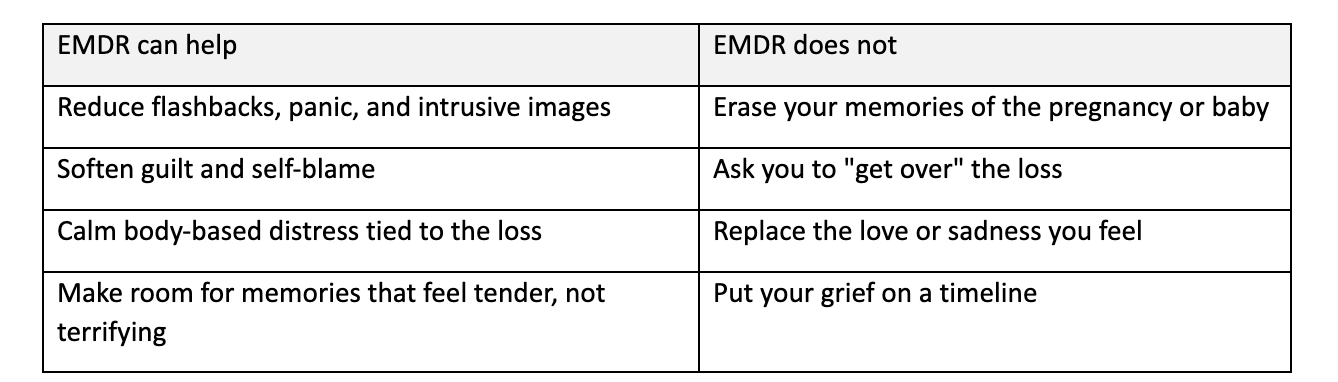
Many people say that after trauma processing, they can finally think about their baby with more love and less fear. Grief can then do what grief does: move, change, and be carried.
What EMDR for Reproductive Loss Can Look Like
EMDR is a structured therapy, and your nervous system sets the pace. Whether you do EMDR in weekly sessions or in a concentrated format, the work usually follows these steps:
Consultation. We talk about what happened, what you are noticing now, and what you hope will feel different.
Preparation. Before we touch painful memories, we build tools to help you feel steady, such as grounding, resourcing, and ways to return to calm.
Choosing targets. Together, we identify the memories, images, body sensations, and beliefs that carry the most distress.
Processing. Using bilateral stimulation, we work through those targets at a pace that keeps you within a manageable level of activation.
Integration. We make space for what comes up afterward, including grief, which is welcome in the room.

Weekly EMDR or an EMDR intensive?
Weekly EMDR works well for many people. But a 50-minute session can end just as you reach the hardest part of the memory, and then you go back to work, a toddler, or a quiet nursery.
An intensive therapy format offers a half day, full day, or two days of focused EMDR. It may be a good fit if you have one specific loss you want to work through, if you feel stuck circling the same pain in weekly therapy, or if weekly appointments are hard to fit around work and family life. Before any intensive, there is a consultation and assessment to make sure the format is safe and right for you.
If you are still physically recovering or lactating after a loss, breaks can be planned around what your body needs. You can learn how EMDR intensives are structured and what each format includes.
EMDR also fits naturally alongside other support. At Wise Roots Therapy, it is often woven together with perinatal therapy and somatic therapy, so both your story and your body are part of healing.
Frequently Asked Questions About EMDR for Pregnancy Loss:
-
Yes. EMDR can help when a miscarriage leaves behind flashbacks, panic, guilt, or body-based distress. It targets the specific memories and beliefs connected to the loss, such as "My body failed me," so they feel less raw. EMDR does not remove grief, but it can make grief feel more bearable.
-
There is no set waiting period. Some people begin within weeks, and others come years later. Early on, therapy often focuses on stabilization and support before processing begins. A consultation and assessment help determine whether you are ready for trauma processing or would benefit from preparation first.
-
Many people do EMDR during a later pregnancy, often to address fear and anxiety after a past loss. Because pregnancy brings physical and emotional changes, pacing matters. Your therapist will discuss your health, stability, and goals during the assessment and may coordinate with your medical provider when appropriate.
-
Yes. Infertility and IVF can involve repeated losses, medical procedures, and cycles of hope and disappointment. EMDR can target specific painful moments, such as a failed transfer or a difficult appointment, along with beliefs like "I'm broken" or "It will never happen for me."
-
It depends on the loss, your history, and how much preparation you need. A single, specific loss may take fewer sessions than repeated losses or earlier trauma. Some people choose a half-day or full-day EMDR intensive to cover more ground in a shorter timeframe.
-
Yes. Pregnancy and infant loss is one of the areas Wise Roots Therapy focuses on in EMDR intensives in Nashville. Intensives offer extended time to process a loss with breaks planned around your needs. A free consultation is the first step to see if this format is a good fit.
Your Baby Mattered. So Does Your Healing.
You do not have to keep reliving the worst day of your life to prove how much you loved your baby. Healing does not mean forgetting. It means being able to hold their memory without your whole body bracing.
At Wise Roots Therapy, Kara Guindin, LCSW, PMH-C, is an EMDR Certified Therapist and Perinatal Mental Health Certified Therapist who specializes in pregnancy loss, infant loss, and reproductive trauma. Whether you want to start with weekly sessions or are ready for focused time in an EMDR intensive for pregnancy and infant loss, you will be met with care, patience, and a pace that honors your story.
Schedule your free 20-minute consultation to talk through what you have been carrying and find out whether EMDR is the right next step. You have held this long enough on your own.
If you are in crisis or having thoughts of harming yourself, call or text 988 to reach the 988 Suicide & Crisis Lifeline, or call 1-833-TLC-MAMA (1-833-852-6262) for the National Maternal Mental Health Hotline.
About the Author
Kara Guindin, LCSW, PMH-C is a licensed therapist in Nashville specializing in trauma, EMDR, and maternal mental health.

Wise Roots Therapy provides specialized trauma and maternal mental health support in Nashville and across Tennessee. Kara Guindin, LCSW, is a Certified EMDR Therapist offering compassionate, research-supported care in a calm and supportive environment.